About Verdera

This is the problem worth solving for the next few decades.

Why this, why now.

The world is tracking toward 2.5–3°C of warming.

That isn't a distant projection anymore: it's the planning assumption for every government, every insurer, every infrastructure operator who is paying attention. Adaptation is no longer a parallel track to mitigation. It is operationally critical, financially material, and institutionally urgent.

The problem isn't will. Decision-makers across governments, development banks, and corporations understand the stakes. What they lack is conviction: the ability to translate risk into defensible, localised, investable decisions. And throughput: the machinery to convert that conviction into capital deployed, projects built, communities protected.

Verdera was built to close both gaps.

"The data exists. The decisions don't. We're fixing the translation layer."

Separately, we'd spent years on the problem. Together, we're building the infrastructure to solve it.

Three forces are converging in a way that didn't exist even five years ago.


Physical climate impacts are no longer probabilistic.

They are operational. Cyclones, floods, heat events, and supply chain disruptions are happening inside the planning horizons of the institutions that need to respond to them, not outside them.

Adaptation capital is scaling.

The $400B+ market today is projected to reach $1T+ by 2030. DFIs, green bonds, and sovereign mandates are all moving in the same direction. The money wants to move. The problem is it has nowhere credible to go fast enough.

AI is, for the first time, capable of encoding contextual, traceable judgement.

Not just retrieving data: reasoning across policy frameworks, engineering constraints, financial models, and community realities simultaneously. That wasn't possible at the precision this domain requires until now. Verdera sits at that intersection: the moment the problem is arriving, the capital is scaling, and the technology is ready.

$400B+ Adaptation market today
$1T+ Projected by 2030
12–14× The adaptation gap in the Global South vs. available capital

Verdera doesn't deliver reports. We embed.

Every deployment is a live system: a dashboard, an agent, a digital twin, built directly into how a client plans, funds, and acts. That means we create traceability for every decision being made. It also means our clients stop relying on bespoke consultants every time a new risk surface emerges. The intelligence compounds.

We think of this as the difference between a diagnosis and a nervous system. Most of what exists in the adaptation space today is diagnostic. We're building the nervous system.

The difference between a diagnosis and a nervous system. Most adaptation today is the former. We're building the latter.
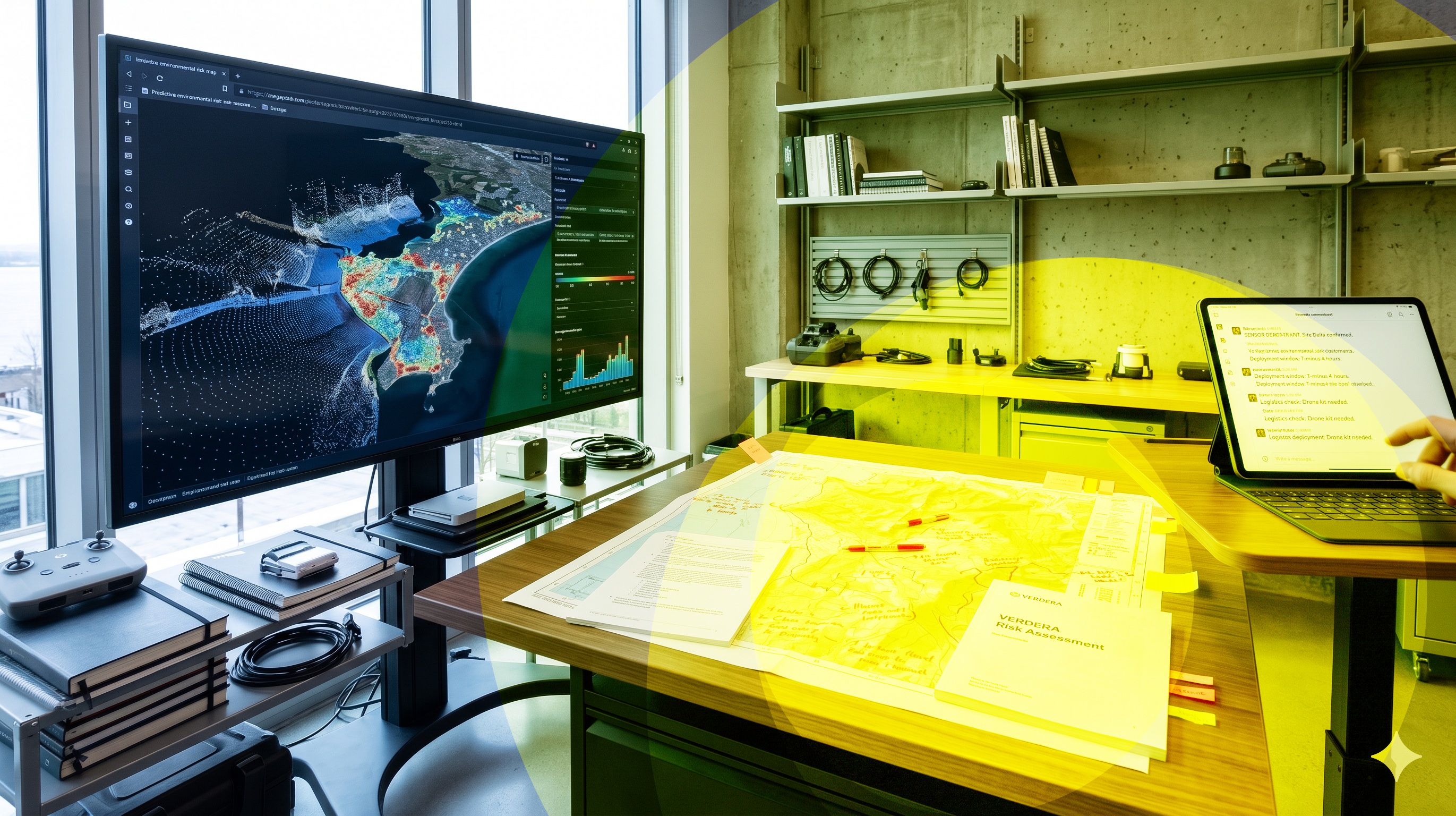
A Verdera deployment in progress

Four principles that shape how we work.

Not as slogans. As operating constraints: things we've found to be true in practice and hold ourselves accountable to in every engagement.

We build, not advise.

We measure success by what the institution can do after we leave. We are trying to produce capability: the machinery to translate risk into decisions, repeatedly, without starting from scratch each time.

We move fast and stay rigorous.

Speed is not the enemy of quality in this domain: slowness is. Every week of delayed adaptation is measurable in lives, livelihoods, and capital lost. We don't sacrifice rigour for pace. We've built processes that do both. That tension, held carefully, is a competitive advantage.

We are optimistic, and clear-eyed.

Adaptation is not a crisis response. It is infrastructure. We don't do doom. We also don't pretend the situation isn't serious. The best thing we can bring to this work is honest optimism, the kind that comes from understanding the problem deeply and still choosing to build the solution.

We are local in delivery, global in scope.

Adaptation fails when it arrives as a generic framework. Every deployment is contextualised to the hazard, the community, the institution, the regulatory environment. But the intelligence underneath it is global. Local fidelity, global learning: that's what makes Verdera scale.

The advice already exists. The problem is that it takes too long, costs too much, and arrives in a form no one can act on. We are fixing all three .

What we're building toward

The catalytic engine that makes adaptation strategic, actionable and profitable

Partner with Us Join the Team